
Understanding Logical Fallacies III
Critical Thinking Skills Series, Part V

Logical fallacies are a real thing. They are not hiding in the shadows; they are real errors in our reasoning that have shaped the behaviour of millions and billions of individuals. This is not some vague concept. It has led to the loss of relationships, jobs, money and even lives.
In the last two posts, I have already discussed six of these fallacies: ad hominem, Straw Man, False case, Slippery slope, False dilemma, and Appeal to authority. To conclude this series on Logical fallacies, let’s explore three more.
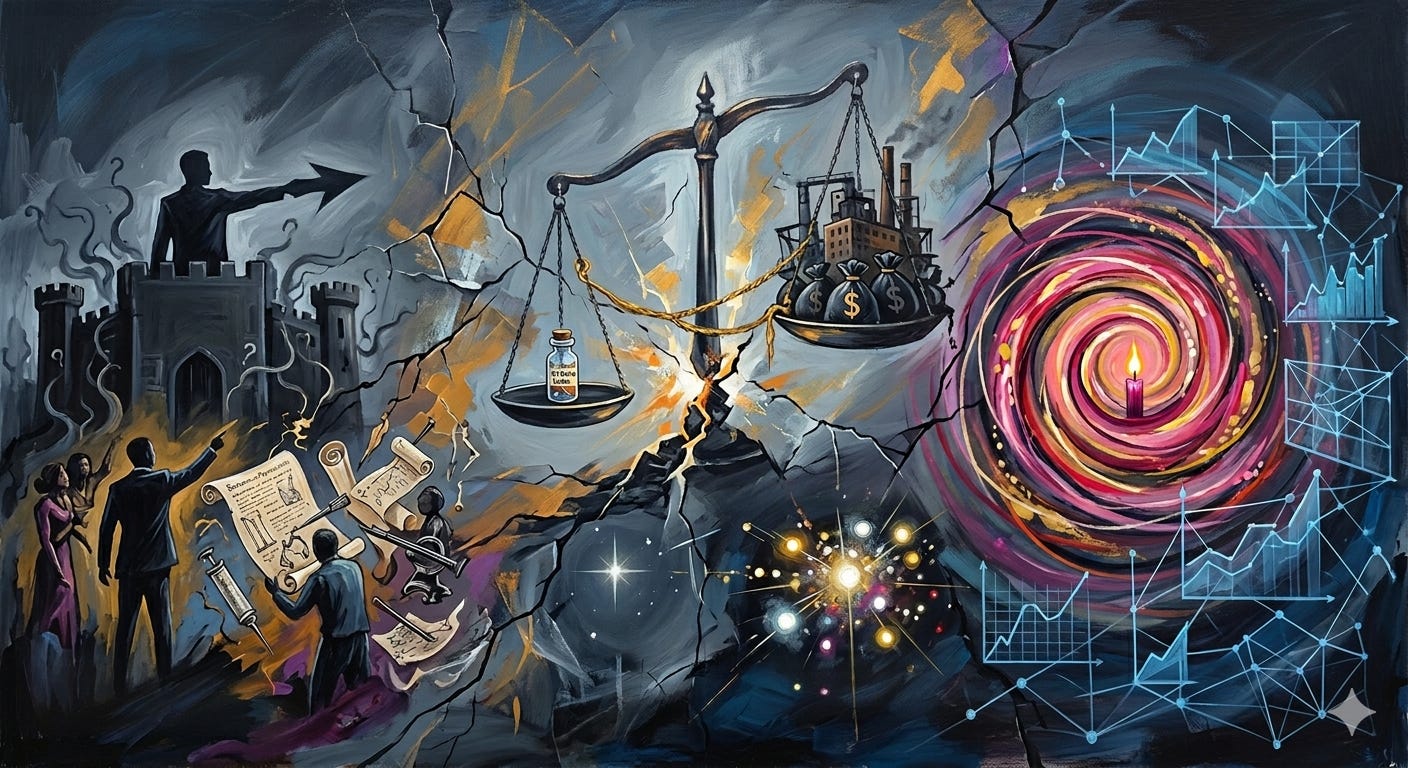
Burden of Proof.
When someone makes a bold claim like ‘The moon landing was faked. Can you prove every single piece of footage is real?’
To the unsuspecting listener or debater, it looks like a strong case. But it’s actually not. Here’s why: the person made a claim - ‘the moon landing was faked’. But, shifted the responsibility of proving evidence to the opposing side, by asking them to present evidence to disprove him - ‘Can you prove every single piece of footage is real?’.
Here is how a logical argument works. When I make a claim, I am to bring concrete evidence to back my claim. I do not shift the burden of proof to the opposing side by asking them to provide evidence to disprove me. That is the foundation of our legal systems, critical thinking and even science itself. We do not shift the burden of proof; we bear it.
Let me clarify: Asking for evidence in itself is not wrong, but failing to back one’s own claims, and rather requesting that the opponent present evidence to disclaim it, is the fallacy.
There is a similar fallacy that is commonly used together with. This is known as the argument from ignorance. Here, it is argued that a lack of evidence is evidence itself. Absurd? Maybe.
Here’s an example: if I claim ‘ we do not have evidence that aliens exist, so aliens do not exist’. It’s faulty logic because I am using the absence of evidence to make a point. Meanwhile, the truth is that there is simply not enough evidence to substantiate for or against that claim.
We often combine these two to make erroneous conclusions. Here’s an example:
Person A claims: “Whistling attracts snakes at night”
Person B challenges: “Where’s your evidence?”
Person A responds: “Do YOU have evidence snakes can’t hear it?” (shifting the burden of proof)
Person A continues: “Since you can’t prove they aren’t attracted, my claim is true” (Argument from ignorance)
It’s way more common than we actually think. And it takes deep thinking to clearly see these things and call them out.
False Equivalence.
This is quite a dangerous one. One that has created so much prejudice. As humans, we love to find connections and links. And it’s way easier to simply create a lazy explanation by focusing on superficial similarities, rather than to dig deep and unmask important, and not so conspicuous differences.
In False Equivalence, people argue that two or more things are the same by overexaggerating similarities and equating them to equivalence. The nuance and complex differences that exist between the two things are undermined instead.
Here is a famous example - The Galileo Gambit.
Centuries ago, a famous scientist named Galileo made bold claims that challenged the norms and authority of his day. He claimed that the Earth revolves around the Sun, tides were a result of the Earth’s movement, Jupiter has moons, and the Earth’s moon has craters, etc.
As a result, he was ridiculed and persecuted greatly, only to be vindicated. It was, however, proven scientifically several years later that he was right all along.
Now, as modern society progresses, we have seen the rise of people who have purported bold claims in different spheres of life. But, rather than provide concrete proofs when met with objections and criticism, they erroneously equate their experience with Galileo’s.
‘Galileo was ridiculed, but he was right. If I am being ridiculed and persecuted, it must mean I am right’
Two things being similar does not make them equal. And people will want to use the burden of proof fallacy to catch their opponents off guard when evidence is asked for.
I have heard sycophants use this fallacy to justify the actions of politicians. Here’s a common one I have heard on the streets of Nigeria:
“Why are we shouting about the Minister who embezzled 50 billion Naira? Even the man on the street gives 100 Naira to the police at a checkpoint. We are all the same in this country; everybody is corrupt.”
But here is the reality: While both involve dishonesty, a citizen paying a 100 Naira bribe under systemic pressure is not equivalent to a high-ranking official stealing billions of public funds meant for hospitals or roads. The scale and impact on the nation’s survival are vastly different. Equating the two is a false equivalence.
Anecdotal Fallacy
Perhaps none is a more powerful pulling force than personal, emotional experiences. And when challenged, we inadvertently accuse others of undermining our experiences - an accusation that makes us all uncomfortable.
This fallacy is one that makes us use personal experiences or an isolated example rather than a sound argument or compelling evidence.Drawing blank and faulty conclusions from personal experiences can be dangerously misleading.
Personal experiences should be thoroughly examined and not used as a basis for further confirmation bias. If not, there will be no standardised reproducible understanding of several factors that could have contributed to such outcomes. Rather, everything is reduced to ‘my personal belief’. This has led to a cultic following that has destroyed so many lives.
When we don’t study our experiences in light of available evidence and simply present our findings as novel facts, we are at risk of misleading ourselves.
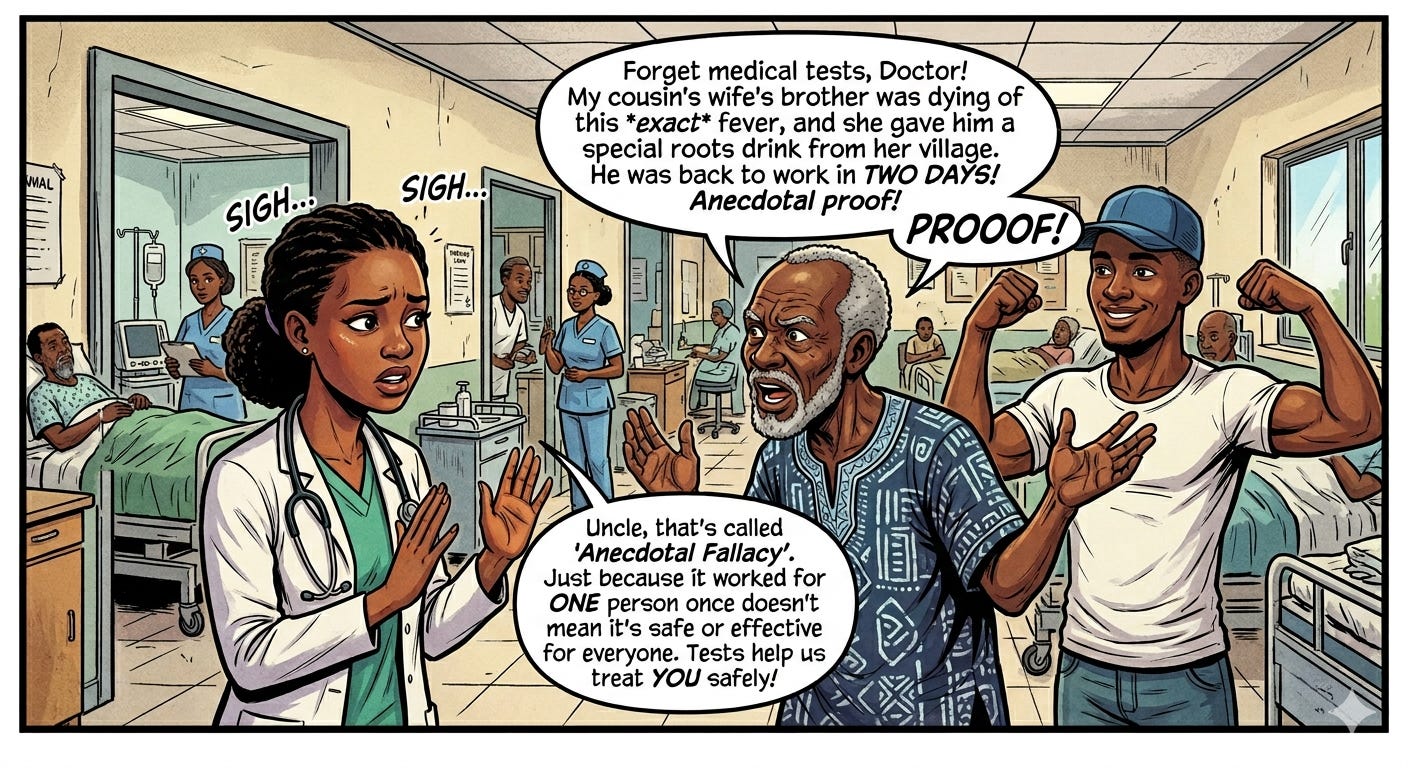
As a Doctor in Nigeria, this is one fallacy I come face-to-face with in the hospital regularly.
‘It worked for me, it must be true’
‘Don’t believe those doctors and their expensive tablets. My uncle had malaria last year. He drank one bottle of ‘Agbo’ (herbal concoction) from a woman in Mushin, and by the next morning, he was playing football. Forget hospitals; Agbo is the real cure.’
Without any diagnosis? Does playing football mean he was cured? How do you ascertain the safety of the ‘Agbo’? etc. Facts weren’t presented. Personal experiences were emotionally used to make an argument, with no clinical trials to support that Agbo safely treats malaria.
It’s also very common when scams are being sold to many. You hear things like:
“I know a guy who put all his savings into this money multiplying scheme and bought a house in Maitama in two months. It’s a guaranteed win.”
Critical thinking forces us to pause and think. To reevaluate the logic of several arguments and convictions that have shaped our behaviours and attitudes in our personal and professional lives.
And for leaders, this is non negotiably a must-have skill, in order to move teams and organisations forward.
Next week, in the final part of this Critical Thinking Skills, we will be exploring how to critically evaluate evidence/facts and opinions. Kindly subscribe so you do not miss out.